Mastering Line Graphs: First Quadrant Essentials
Line graphs are everywhere—from dashboards that track monthly revenue to classroom charts showing plant growth. Yet many people never move beyond plotting points in a basic two-axis mist. Mastering line graphs in the first quadrant is about anchoring your data in clarity, because almost every meaningful trend you’ll visualize lives where both variables are positive. Whether you’re a marketer watching click-through rates climb, a small business owner monitoring weekly sales, or an educator designing engaging lesson materials, the ability to construct and interpret a clean first-quadrant line graph transforms raw numbers into decisions.
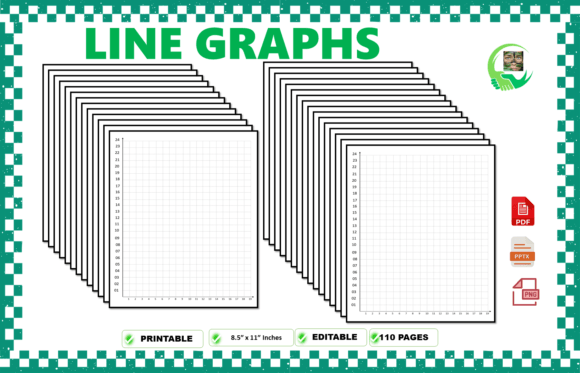
This guide isn’t just about drawing lines. It’s about building a thoughtful relationship with data. The resource Mastering Line Graphs: Data Visualization Made Easy offers a 110-page deep dive into that relationship—with step-by-step methods, ready-to-edit PPT source files, and print-ready PDFs that let you prototype, customize, and repeat. But before you open the book, let’s explore the creative, practical, and often overlooked power of focusing exclusively on the first quadrant.
Why the First Quadrant Anchors Real-World Clarity
In the Cartesian plane, the first quadrant is the zone where x ≥ 0 and y ≥ 0. For most everyday data stories, this is the only area that matters. Time progresses forward, not backward. Quantities like revenue, subscribers, temperature in Celsius above freezing, or completed tasks are non-negative. By restricting your coordinate system to the first quadrant, you eliminate visual noise and help your audience instantly grasp the message without mentally filtering impossible negative values.
Think of it as creating a trustworthy frame. When you present a sales trend, starting both axes at zero (or a clearly labeled non-zero baseline) in the first quadrant ensures that slopes and curves aren’t exaggerated or misleading. This builds credibility with clients, colleagues, and readers. The book Mastering Line Graphs emphasizes choosing appropriate scales and labeling axes—skills that become second nature once you internalize the first-quadrant mindset. You’ll stop wondering if your graph is “accurate enough” and start knowing it’s honest.
Plus, first-quadrant graphs are simpler to digitize. Many software tools and spreadsheet defaults nudge you toward quadrant one anyway. Understanding its logic helps you override bad defaults and make intentional design choices that serve your specific data set.
Turning Numbers into Stories with Minimal Elements
A line graph thrives on economy. All you need is a horizontal axis (often time), a vertical axis (the measured value), plotted points, and connecting lines. In the first quadrant, the story unfolds from left to right and bottom to top. This natural reading direction aligns with how we process sequential information. Suddenly, a dry list of weekly website visits becomes a journey: “Here’s where we started, here’s where we dipped, and here’s where strategy pivoted and traffic surged.”
To master this, experiment with varying line styles. A solid thick line communicates confidence; a dashed line can denote projections or secondary scenarios. Use color strategically—perhaps a bold blue for your primary metric and a softer gray for a comparative benchmark. The book’s PPT source files are editable, so you can swap brand colors, adjust line weights, and even repurpose graph skeletons for social media graphics, client proposals, or educational handouts. That flexibility is pure gold for creators and freelancers who need to maintain visual consistency across platforms.
Remember, the first-quadrant constraint doesn’t mean boring. You can still convey seasonality, exponential growth, plateaus, and anomalies. The key is to let the data shape the narrative, not the quadrant limits. Often, limiting the canvas forces you to be more creative with what you highlight.
Practical Applications Across Different Roles
For marketers and bloggers: Use first-quadrant line graphs to visualize email open rates over a 12-month campaign. Plotting months (1–12) on the x-axis and percentage opens (0–100%) on the y-axis immediately shows which subject line strategies worked. You can even overlay multiple lines to compare A/B test results without leaving the positive zone. This keeps performance reviews fact-based and action-oriented.
For entrepreneurs and small business owners: Cash flow projections make or break decisions. A first-quadrant line graph with “week of the quarter” on the x-axis and “bank balance” on the y-axis helps you spot dangerous dips before they become crises. Because you’re only dealing with positive balances (and zero as a floor), the graph feels intuitive. Pair it with a horizontal reference line at your break-even point, and you’ve got a dashboard that tells the whole financial story at a glance.
For educators and publishers: Teaching young learners about graphing often starts with the first quadrant. It’s less intimidating and directly ties to real-world measurement—height over time, distance traveled, or daily rainfall. The book’s PDF files are designed with bleed and high-resolution output, so you can print crisp worksheets, posters, or interactive notebook pages. Even adult learners in professional development workshops benefit from revisiting these fundamentals before tackling negative axes.
For designers and content creators: Infographics thrive on clean, scannable data. A first-quadrant line graph tucked into a social media post needs no legend if it’s self-explanatory. Keep the background minimal, use rounded endpoints, and maybe animate the line drawing in a video presentation. The editable source files mean you can repurpose the exact same data for a blog header, an Instagram story, and a client report without rebuilding from scratch.
Creative Project Ideas to Sharpen Your Skills
Mastery grows when you apply concepts to personal or community projects. Here are a few starting points that go beyond textbook exercises:
- Track a 30-day habit. Create a simple line graph with days on the x-axis and the number of minutes spent reading, meditating, or coding on the y-axis. The upward (or fluctuating) line becomes a visual commitment device. Add a dotted trend line that forecasts where you’ll be in 60 days if you maintain the habit.
- Design a “business health” snapshot. Small business owners can plot monthly revenue for the current year and overlay the previous year’s data. Using only the first quadrant, apply distinct colors and a subtle shaded area between the lines to highlight growth gaps. This creates a one-glance report for stakeholders.
- Map a learning curve. If you’re learning a new skill—say, video editing—chart your project completion times over the first 20 attempts. The descending line (time decreasing as proficiency increases) proves progress even when it feels slow. Share it on LinkedIn to document your journey, sparking conversation and accountability.
- Experiment with “projected vs. actual” in nonprofit fundraising. Plot donation progress during a campaign, with a solid line for actual dollars and a pale, dashed line for the goal trajectory. Keep both lines within the first quadrant, and use annotation markers to call out key moments, like a matching grant day.
In each case, the constraints of the first quadrant push you toward simplicity. And simplicity, when done right, is the most powerful form of sophistication in data visualization.
Steering Clear of Common First-Quadrant Mistakes
Even within the safe boundaries of positive values, it’s easy to mislead or confuse your audience. One frequent error is truncating the y-axis without clear notation. If your scale starts at 50 instead of 0 to emphasize small changes, add a break symbol or annotate clearly. Otherwise, a 2% increase can look like a 200% spike. The book’s chapter on scale selection walks you through ethical and effective choices, ensuring your graphs inform rather than manipulate.
Another trap: cluttering the quadrant with too many lines. Three overlapping lines can turn into spaghetti if not differentiated well. Stick to a maximum of four data series, and use direct labeling instead of a distant legend. If you must include more, consider a small multiples layout—a series of mini first-quadrant graphs that share the same scale, making comparison effortless.
Also, watch your time axis. Irregular intervals (like skipping weekends or using non-chronological months) can distort the shape of the line. Always space time intervals proportionally or explicitly state when they’re equal. This keeps your x-axis honest and your trend lines truthful.
Using “Mastering Line Graphs” as Your Hands-On Companion
The 110-page resource isn’t a dusty theory tome. It’s built for doers. The inclusion of PPT source files means you can drag, drop, and edit every example. Have a brand palette? Paste it in. Need to translate axis labels for an international team? Type them directly. The high-quality print-ready PDF and PNG files ensure that whether you’re presenting on a 27-inch monitor or printing an A3 poster, your graph stays crisp.
One often-overlooked gem: the book’s exercises. They walk you through building graphs from scratch, but then challenge you to reinterpret the same data for different audiences—a student, a CEO, a general public reader. This forces you to adjust title language, axis labels, and emphasis while staying inside the first quadrant. Like any creative skill, deliberate practice with varied contexts accelerates mastery.
As you work through the material, you’ll notice your “graph intuition” sharpening. You’ll start seeing poor first-quadrant graphs online and mentally redesign them. That’s the real transformation—moving from passive consumer to confident communicator who understands that a well-crafted line graph can change minds, secure budgets, and simplify the complex.
Ultimately, mastering line graphs in the first quadrant isn’t about perfection on day one. It’s about consistent, mindful practice. Every graph you create, whether for a freelance project, a classroom, or your own startup dashboard, is an opportunity to refine your message. With the right tools and a sturdy conceptual foundation, your data stories will land with clarity, credibility, and creative impact.
